

400G vs 800G Optical Transceivers: How to Choose the Right Module for AI Data Centers
As AI workloads, cloud computing and high-performance computing continue to expand, data center networks are moving toward higher bandwidth, lower latency and higher port density. For many network operators, 400G remains a mature and reliable choice, while 800G is becoming increasingly important for AI clusters, GPU interconnects and next-generation switching infrastructure.
Choosing between 400G and 800G optical transceivers is not only about speed. Customers also need to consider transmission distance, fiber type, form factor, connector type, breakout requirements, switch compatibility, power consumption and future upgrade planning.
This article explains the key factors to consider when selecting 400G and 800G optical transceivers for AI data centers and high-speed network deployments.
1. Understanding 400G Optical Transceivers
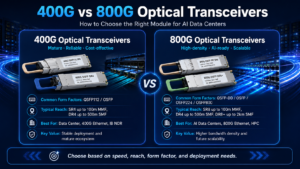
400G optical transceivers are widely used in modern data centers, Ethernet switching networks and InfiniBand interconnect applications. They provide a strong balance between performance, maturity and deployment cost.
Typical 400G options include:
- 400G QSFP112 SR4
- 400G OSFP SR4
- 400G OSFP112 DR4
For short-reach multimode fiber links, 400G SR4 modules are commonly used for rack-to-rack or switch-to-switch connections inside data centers. For longer single-mode links, 400G DR4 modules can support 500m-class transmission distance.
400G is often suitable for customers who need stable high-speed connectivity with a mature ecosystem and broad equipment support.
2. Understanding 800G Optical Transceivers
800G optical transceivers are designed for higher-density data center networks, AI training clusters and next-generation cloud infrastructure. Compared with 400G, 800G provides higher bandwidth per port and can help reduce the number of physical links required in high-capacity network architectures.
Typical 800G options include:
- 800G QSFP-DD SR8
- 800G OSFP SR8
- 800G OSFP224 DR4
- 800G OSFP800 DR8+
800G SR8 modules are mainly used for short-reach multimode fiber connections, while 800G DR4 and DR8+ modules are used for single-mode fiber applications. Some 800G modules also support breakout applications such as 2x400G, 4x200G or 8x100G, which can be useful during network migration.
For AI data centers, 800G is especially important when high bandwidth density, large-scale GPU clusters and future network scalability are required.
3. SR, DR and DR+: Choosing the Right Reach
Transmission distance is one of the most important factors in optical module selection.
SR Series: Short-Reach Multimode Links
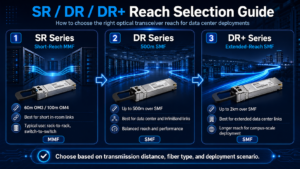
SR modules are designed for short-reach multimode fiber connections. They are commonly used in high-density data center environments where transmission distance is usually within the same room or between nearby racks.
Typical reach:
- 60m over OM3 multimode fiber
- 100m over OM4 multimode fiber
Typical products:
- 400G QSFP112 SR4
- 400G OSFP SR4
- 800G QSFP-DD SR8
- 800G OSFP SR8
SR modules are suitable for short-distance, high-density and cost-sensitive interconnect applications.
DR Series: 500m Single-Mode Links
DR modules are used for single-mode fiber links, typically supporting longer transmission distance than SR modules.
Typical reach:
- Up to 500m over single-mode fiber
Typical products:
- 400G OSFP112 DR4
- 800G OSFP224 DR4
- 1600G OSFP224 DR8
DR modules are suitable for data center interconnects, Ethernet switching and InfiniBand applications where longer reach is required.
DR+ Series: Extended-Reach Single-Mode Links
DR+ modules are designed for longer single-mode fiber links. For example, 800G OSFP800 DR8+ can support extended-reach data center links up to 2km.
DR+ is useful when customers need high-speed connectivity across longer distances inside large data center campuses or between network zones.
4. Form Factor: QSFP112, QSFP-DD, OSFP, OSFP224 and OSFP800
Before selecting an optical transceiver, customers should confirm the supported form factor of their switch or network platform.
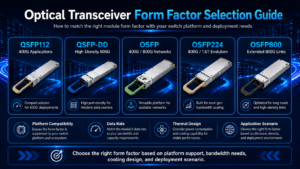
Common form factors include:
- QSFP112
- QSFP-DD
- OSFP
- OSFP224
- OSFP800
QSFP112 is commonly used for 400G applications. QSFP-DD and OSFP are widely used in 800G deployments. OSFP224 is used for next-generation 800G and 1.6T applications, while OSFP800 is used in specific 800G high-speed designs.
Choosing the wrong form factor can cause compatibility issues, even if the data rate and reach are correct. Therefore, switch model and port type should always be confirmed before quotation or purchase.
5. Fiber Type and Connector Type
The fiber infrastructure must match the optical module type.
For SR modules, multimode fiber is normally required. Common fiber types include OM3 and OM4. For DR and DR+ modules, single-mode fiber is normally required.
Common connector types include:
- MPO-12 APC
- MPO-16 APC
- Dual MPO-12 APC
Before selecting a module, customers should confirm the existing cabling system, fiber type and connector interface. This helps avoid mismatch problems during installation.
6. Breakout Applications
Breakout capability is another important factor in 800G network planning.
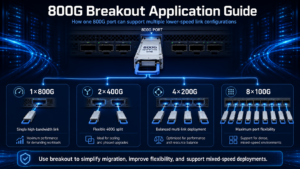
Some 800G optical transceivers can support different breakout configurations, such as:
- 1x800G
- 2x400G
- 4x200G
- 8x100G
This is useful when customers are migrating from 100G, 200G or 400G networks toward 800G infrastructure. Breakout support allows one high-speed port to connect with multiple lower-speed ports, improving flexibility during phased upgrades.
However, breakout applications require support from the optical module, switch platform, port configuration and cabling system. These details should be checked before deployment.
7. Power Consumption and Thermal Design
As data rates increase, power consumption and thermal management become more important. 800G and 1.6T optical modules usually require better cooling and more careful system-level thermal planning than lower-speed modules.
Customers should consider:
- Module power consumption
- Switch cooling capability
- Airflow direction
- Operating temperature range
- Port density
- Long-term stability
This is especially important for AI data centers, where high-density switches and GPU clusters generate significant heat.
8. Compatibility Check Before Purchase
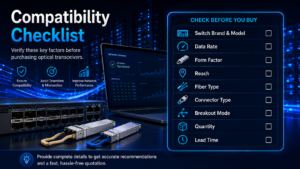
Compatibility is one of the most common concerns when sourcing optical transceivers. Before ordering, customers should provide as much information as possible, including:
- Switch brand and model
- Required data rate
- Form factor
- Transmission distance
- Fiber type
- Connector type
- Breakout mode
- Quantity
- Delivery schedule

With this information, the supplier can help check suitable product options, stock availability and potential compatibility requirements.
9. Recommended Selection Process
A simple selection process can help reduce mistakes:
- Confirm the required data rate: 400G, 800G or 1.6T
- Confirm the transmission distance: 100m, 500m or 2km
- Confirm the fiber type: MMF or SMF
- Confirm the form factor: QSFP112, QSFP-DD, OSFP, OSFP224 or OSFP800
- Confirm the connector type: MPO-12, MPO-16 or Dual MPO-12
- Confirm switch compatibility and breakout requirements
- Check stock availability, lead time and technical documentation

Data Rate → Reach → Fiber Type → Form Factor → Connector → Compatibility → Stock & Lead Time
This process helps customers choose optical modules based on real deployment requirements instead of only comparing part numbers.
Conclusion
Both 400G and 800G optical transceivers play important roles in modern data center networks. 400G modules remain a mature and reliable choice for many Ethernet, InfiniBand and cloud infrastructure applications. 800G modules provide higher bandwidth density and are becoming increasingly important for AI data centers, GPU clusters and next-generation high-performance networks.
For short-reach multimode links, SR modules are usually the preferred option. For 500m single-mode links, DR modules provide a practical solution. For longer 800G interconnect requirements, DR+ modules can support extended-reach applications.
Senway OpticLink provides 400G, 800G and 1.6T optical transceiver sourcing and technical coordination support. If you are planning a data center, AI network, cloud infrastructure or HPC connectivity project, send us your required data rate, switch model, transmission distance, connector type, fiber type and quantity. Our team will help check suitable product options, stock availability and compatibility requirements.